Switch and control, on your own rules.
Switch load, valves and equipment on your own rules: a tariff, a schedule, a demand limit, or a live reading from another sensor. Set it once, and Augos acts.









You are reacting to tariffs and loadshedding by hand.
Switching load for a demand peak or a tariff window, or opening a valve on a schedule, all of it depends on someone remembering to do it at the right moment. Miss it, and it costs you.
Peaks you pay for
A demand peak sets your bill for months, but shedding load before it happens relies on someone watching the clock.
Expensive hours
Running heavy load in a peak tariff window costs far more, yet nothing switches it off on its own.
Loadshedding scramble
When the power drops, someone has to switch equipment down safely, and switch it back, every single time.
Irrigation by memory
Valves opened and closed by hand get forgotten, over-watering one block and starving another.
Set the rule once, and Augos does the switching.
Control is the acting layer. Tell Augos what to switch and when, and it moves a switch or a valve on its own, driven by a tariff, a schedule, a demand limit, or a live reading from any sensor.
Measure the driver
Site demand, the tariff clock, or a live reading from any Augos sensor, whatever the decision runs on.
Set the rule
Shed above a demand limit, switch off in a peak tariff window, or open a valve on a schedule.
It acts on its own
A switch or a valve moves automatically, and you get a message confirming it, or warning you if it did not.
The switches and valves.
Each is a wireless control device you add where you need it, on the same platform as your sensors.
Where sites put it to work.
Shed load before a peak
Switch non-essential load automatically as demand approaches your limit, so you never set a new peak.
Follow the tariff
Move heavy load out of expensive windows on your tariff, on its own.
Ride out loadshedding
Switch equipment down and back up safely around a loadshedding schedule.
Automate irrigation
Open and close valves on a schedule, or on a live soil-moisture reading, with no one on site.
Remote sites
Switch a pump or a gate at a site with no one there, from the platform or on a rule.
Tank and pump control
Start and stop a pump on a tank level, so it never runs dry or overflows.
One place for every sensor and site.
Every parameter here runs on the same wireless platform: a live dashboard, custom alerts on your thresholds, intelligent control, and data export. See how it fits together on the Augos Sense overview, or browse the other seven areas.
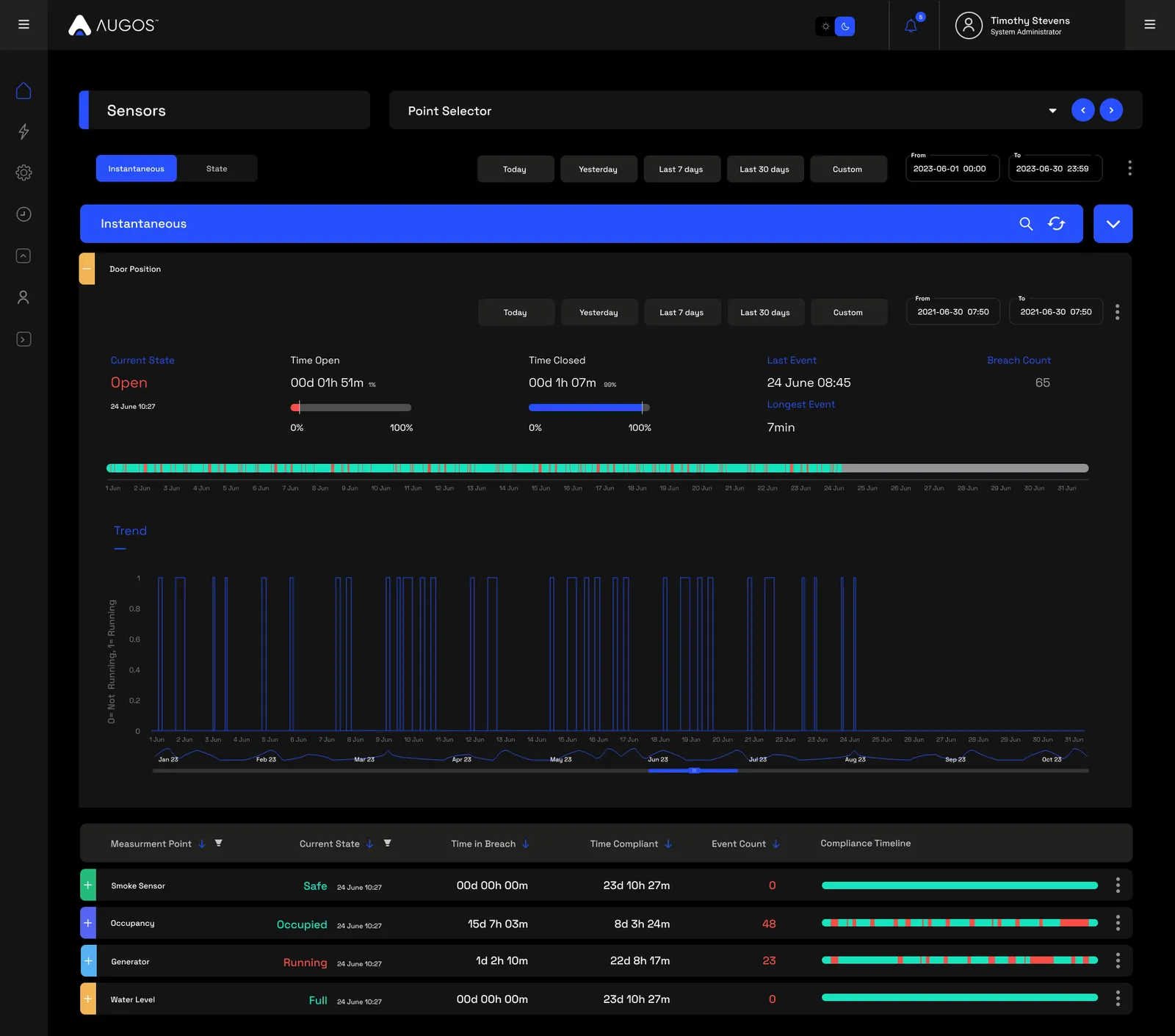
Set the limits that matter, and hear about it the moment a threshold is exceeded.
Set the limit that should act, a demand cap, a tariff window, or a reading from another sensor. The instant it is reached, the switch moves and you get a message, on WhatsApp, email or SMS.
Wireless switches and valves.
to follow
Wireless switches and valve controllers, solar or battery-powered, that act on your rules and report every switch back to the platform.
Start with a single sensor. No rip-and-replace and no commitment, one sensor live in 48 hours, and you add more once it proves out.
Book a demoCommon questions.
How do the sensors connect?
Wirelessly, over LoRa, NB-IoT or Sigfox, chosen for the coverage and density of your site. There is no wiring to run.
How long do the batteries last?
Years. The sensors are low-power and report on a schedule, or when a reading changes, so there is no mains and no cabling to plan for.
How fast can we install?
A single-sensor pilot is typically live within 48 hours of order. You add more sensors and sites the same way.
What can it alert on, and how?
Set an upper limit, a lower limit or a rate of change on any sensor. The moment one is passed, the right person gets a message on WhatsApp, email or SMS.
Where does the data go?
Into one cloud platform, hosted in South Africa. Watch it live, set alerts, chart it, or export it for your own tools or an AI model.
How are you priced?
Per sensor, plus connectivity monthly and the platform per deployment. The single-sensor pilot is the standard way in.
Start with a single sensor.
Book a short call. Tell us what you need to watch, and we'll show you the sensor, the alerts and the control working on your own site.
Book a demo