Monitor health, safety and the environment.
The conditions that keep your people safe and your site compliant. The hardware mix for this area is being finalised, so talk to us about your use case.









Safety depends on conditions no one is watching.
Heat, gas, dust and noise all affect whether a site is safe to work in, but most of it is spot-checked, if at all. The gaps are where incidents happen.
Conditions drift unseen
Heat, gas and dust build up between checks, and the first sign is someone affected.
Incidents with no record
When something happens, there is no continuous record of the conditions around it.
Slow to respond
Nothing links a dangerous condition to an alert, so response waits on someone noticing.
Compliance by paperwork
Conditions logged by hand, hard to keep current and harder to trust.
One sensor turns a blind spot into a live reading.
Put a sealed, battery-powered sensor on each condition you care about. It reports to one cloud platform, and Augos does the watching, so you only hear about it when something moves.
Measure it
A wireless sensor on each condition, reporting to the minute, for years on a battery, with no wiring to run.
Get told
Set the range that matters. The moment a reading passes it, you get a message on WhatsApp.
Act on it
Trigger an alarm or an extractor automatically when a condition crosses a safe limit, and alert the right person at once.
The HSE parameters.
Each parameter is a separate sensor, so you deploy only the ones you need and add more anytime.
Heat stress
Wet bulb and temperature for worker safety.
Gas exposure
Harmful gases where people work.
Dust
Airborne dust and particulates.
Where sites put it to work.
Heat-stress monitoring
Wet bulb where people work, so you call a stop on live numbers.
Gas and confined spaces
Watch for harmful gas around confined and hazardous areas.
Dust and air quality
Track particulates where dust is generated.
Incident awareness
Continuous conditions, so a response starts the moment something crosses a limit.
One place for every sensor and site.
Every parameter here runs on the same wireless platform: a live dashboard, custom alerts on your thresholds, intelligent control, and data export. See how it fits together on the Augos Sense overview, or browse the other seven areas.
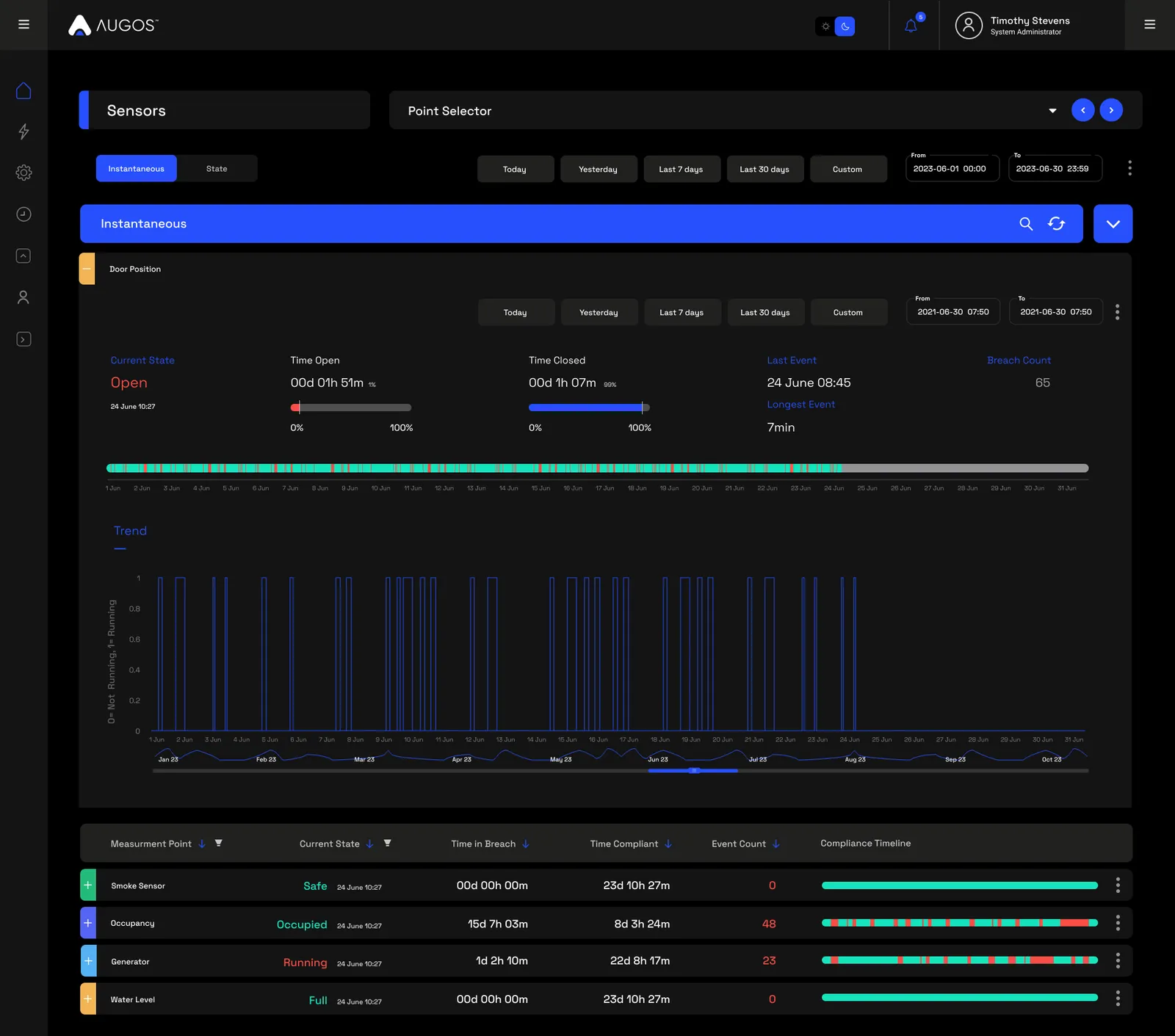
Set the limits that matter, and hear about it the moment a threshold is exceeded.
Set an upper limit, a lower limit, or both for any sensor here. The instant a reading passes it, the person who can act gets a message, on WhatsApp, email or SMS.
Hardware being finalised.
to follow
The HSE hardware mix is being finalised, drawing on the same sensor family. Tell us what you need to keep safe, and we will advise.
Start with a single sensor. No rip-and-replace and no commitment, one sensor live in 48 hours, and you add more once it proves out.
Book a demoCommon questions.
How do the sensors connect?
Wirelessly, over LoRa, NB-IoT or Sigfox, chosen for the coverage and density of your site. There is no wiring to run.
How long do the batteries last?
Years. The sensors are low-power and report on a schedule, or when a reading changes, so there is no mains and no cabling to plan for.
How fast can we install?
A single-sensor pilot is typically live within 48 hours of order. You add more sensors and sites the same way.
What can it alert on, and how?
Set an upper limit, a lower limit or a rate of change on any sensor. The moment one is passed, the right person gets a message on WhatsApp, email or SMS.
Where does the data go?
Into one cloud platform, hosted in South Africa. Watch it live, set alerts, chart it, or export it for your own tools or an AI model.
How are you priced?
Per sensor, plus connectivity monthly and the platform per deployment. The single-sensor pilot is the standard way in.
Start with a single sensor.
Book a short call. Tell us what you need to watch, and we'll show you the sensor, the alerts and the control working on your own site.
Book a demo