Augos Sense / Air quality & safety
Air quality and safety sensing
Measure the air your people breathe.
Particulates, gases and smoke, measured continuously wherever people work. Get alerted the moment a level climbs past a limit you set, and clear the area before it becomes a problem.
Augos Sense is wireless IoT sensing for South African sites: battery-powered sensors that measure temperature, humidity, air quality, level, flow, pressure and equipment state, one cloud platform that checks every reading against the limits you set and alerts on WhatsApp, email or SMS, and switches and valves that act on your rules.
Priced per sensor, plus connectivity and the platform, quoted ex VAT
A single sensor can be live in 48 hours, with no wiring to run.
The problem
You cannot see what your people are actually breathing.
Dust, fumes and gases build up where people work, and by the time anyone smells or feels them, the exposure has already happened. A handheld reading once a year tells you nothing about the shift that mattered.
1
Exposure you never logged
A spike in dust or solvent fumes comes and goes on a shift, and nothing records that it happened or who was there.
2
Gas that gives no warning
Carbon monoxide and other gases have no smell at low levels, so the first sign of a problem can be someone collapsing.
3
A fire caught too late
Smoke in a store or plant room goes unnoticed until it is a real fire, not a small one.
4
No idea when it happened
When exposure is queried, there is nothing to show what the air was doing, when, or for how long.
The method
One sensor turns a blind spot into a live reading.
Put a sealed, battery-powered sensor on each condition you care about. It reports to one cloud platform, and Augos does the watching, so you only hear about it when something moves.
1
Measure it
A wireless sensor on each condition, reporting as often as every minute, on a battery, with no wiring to run.
2
Get told
Set the range that matters. The moment a reading passes it, you get a message on WhatsApp, email or SMS.
3
Act on it
Trip an extractor or an alarm automatically when a level climbs, or send someone to clear the area before it gets worse.
What we measure
The air quality parameters.
Each parameter is a separate sensor, so you deploy only the ones you need and add more anytime.
Particulate matter
Fine dust and particles.
In the knowledge base ›VOC
Solvent and fuel vapours.
In the knowledge base ›NO2
Nitrogen dioxide, a combustion gas.
In the knowledge base ›SO2
Sulphur dioxide.
In the knowledge base ›CO & CO2
Carbon monoxide and carbon dioxide.
In the knowledge base ›Smoke
Smoke from combustion or fire.
In the knowledge base ›Alerts and thresholds
Set the limits that matter, and hear about it the moment a threshold is exceeded.
Set an upper limit, a lower limit, or both for any sensor here. The instant a reading passes it, the person who can act gets a message, on WhatsApp, email or SMS.
CO2 in an office against an upper limit
IllustrativeMessage sent
Office CO2 is above its limit
1,010 ppm at 11:00, past your 1,000 ppm upper limit.
Twice in one day, each time with a message, so ventilation can follow what the air needs.
Illustrative office and readings, not a customer. The limit, the recipients and the channel are the ones you set.
Use cases
Where sites put it to work.
Worker exposure
Dust, VOCs and gases where people work, alerting the moment a level climbs so the area can be cleared.
Combustion and confined spaces
CO and CO2 around engines, boilers and confined spaces, watched continuously.
Early fire warning
Smoke sensing in stores and plant rooms catches a problem while it is still small.
Process and odour
Track emissions and odour from a process so you can act before a complaint does.
Indoor air quality
CO2 and particulates in offices and public spaces, so ventilation follows what the air needs.
Spray and paint booths
VOCs where solvents are used, so extraction and PPE match the real load.
The hardware
Sealed sensors for the air.
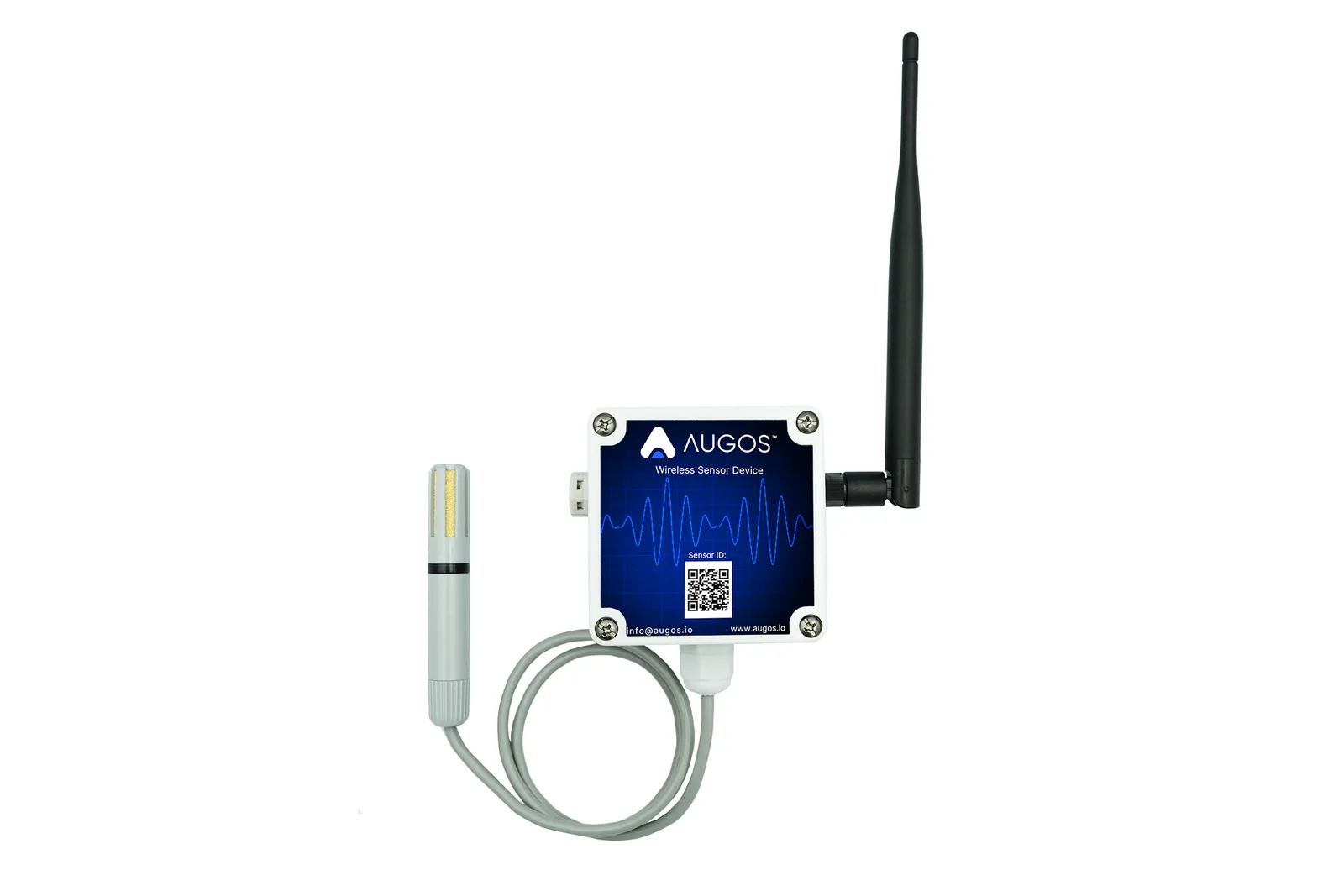
A sealed, battery-powered Augos wireless sensor, fitted with the probe for the gas or particulate you need to watch, mounted where people work and reporting over low-power wireless.
- Wireless: LoRa, NB-IoT or Sigfox, chosen for the coverage and density of your site.
- Battery-powered: no mains and no cabling to plan for.
- Work-area: mounted where people are.
Start small
Start with a single sensor.
No rip-and-replace and no commitment: a single sensor can be live in 48 hours, and you add more once it proves out. Sensors mount magnetically, with no wiring to run and no calibration to perform.
Augos Sense is priced in three parts: the sensors, priced per sensor by what each one is built to measure; connectivity, a monthly cost per sensor; and the platform, one charge per deployment. Figures on request: we size a quote, ex VAT, to the sensors and sites you need.
Questions
How do the sensors connect?
Wirelessly, over LoRa, NB-IoT or Sigfox, chosen for the coverage and density of your site. There is no wiring to run.
How long do the batteries last?
Years, depending on the sensor and how often it reports: the temperature sensor runs up to about two years on a full charge, configuration dependent. Sensors report at intervals you set, from once a minute to a few times an hour, and need no mains and no cabling.
How fast can we install?
A single sensor can be live in 48 hours. Sensors mount magnetically, with no wiring and no calibration, so a site electrician or your own team can fit them without downtime. You add more sensors and sites the same way.
What can it alert on, and how?
Set an upper limit, a lower limit or a rate of change on any sensor. The moment one is passed, the right person gets a message on WhatsApp, email or SMS.
Where does the data go?
Into one cloud platform, hosted in South Africa. Watch it live, set alerts, chart it, or take it out as a download, by API or as an AI-ready export.
How are you priced?
Per sensor, plus connectivity monthly and the platform per deployment, quoted ex VAT. The single-sensor pilot is the standard way in.
Start with a single sensor.
Book a short call. Tell us what you need to watch, and we'll show you the sensor, the alerts and the control working on your own site.