Augos Factory / Industries / Steel and building materials
Steel processing, roll forming and building materials
The same coil change. Three sites. Three different times.
Slitting, cut-to-length, roll forming, pressing and kiln lines lose time in coil and tool changes. Augos Factory times each one against its standard and your own fastest.
From R4,950 per line per month, ex VAT
Fastest sitetypical best coil change
Steadiest sitetypical best coil change
Slowest sitetypical best coil change
Each ring runs to 15 minutes. The blue arc is the site's typical best: the median change time for the product it changes over fastest.
An early Augos study · one anonymised steel processor, three sites · site, products and people removed.
Where steel and building-material lines lose time
Four losses this industry knows well.
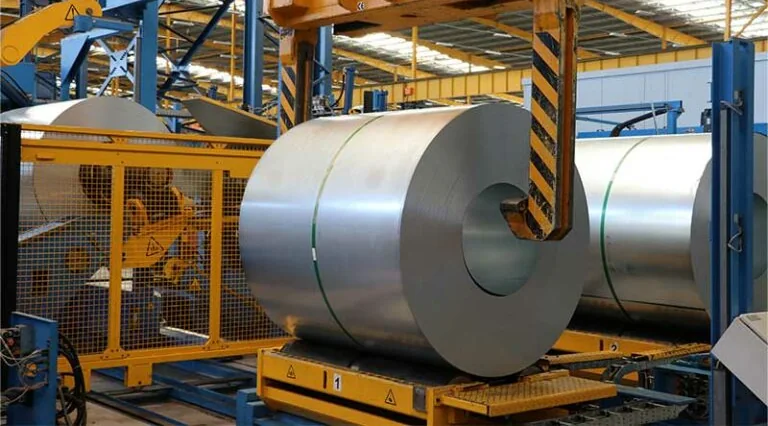
Coil and tool changes
Every change timed from last good part to first good part, per changeover reason.
Set-up and first-off checks
Run-up time and scrap on the first parts, counted against the job.
Material and crane waits
Waiting for a coil, a crane or a forklift, recorded as its own loss, with its root in the reason tree.
Kiln and press stops
Breakdowns timed from stop to restart, split into response and repair with maintenance calls.
An early Augos study · 2,934 coil changes at three sites
Every minute past the blue line is time the site has already beaten.
An early Augos study · one anonymised steel processor, three sites, 2,934 coil changes · site, products and people removed.
Coil-change times by site
Measured · box shapes illustrativeAn early Augos study · one anonymised steel processor, three sites, 2,934 coil changes. Benchmarks, averages, spread ratios and hours are from the study report; box and whisker shapes are illustrative. Site, products and people removed.
What the spread could be worth
Estimate what the time past the benchmark is worth.
The hours are measured. The rand figure is your own estimate: pick a value close to what an hour of net production earns your line.
An hour of net production, as examples. How to estimate it ›
Coil-change time above benchmark, your own estimate
Hours measured · example valueR966,780
537.1 hours above each site's own benchmark, at an example R1,800 an hour of net production
Hours from the study report. The platform shows the hours; the rand figure is your own estimate at an example value. Time already spent is a measure of the gap, not money in the bank.
Where to start
Three sites, three different jobs.
1 · Slowest site
Settle the method
The most time past its benchmark, 286.7 hours, and changes scattered 12.5 times as widely as at the steadiest site. Check long stops logged as coil changes first.
Who acts: engineering, with standard work
2 · Fastest site
Repeat its own best
The quickest benchmark, 6.6 minutes, yet 72% of its change time ran past it. The fast method exists; it is not yet the norm on every shift.
Who acts: training, team by team
3 · Steadiest site
The reference process
Its coil changes vary the least, and only 40% of its change time ran past its own benchmark, the lowest of the three. Its way of working is the one to write down and carry across.
Who acts: group operations, across sites
Built for the floor
Made for a heavy-industry floor.
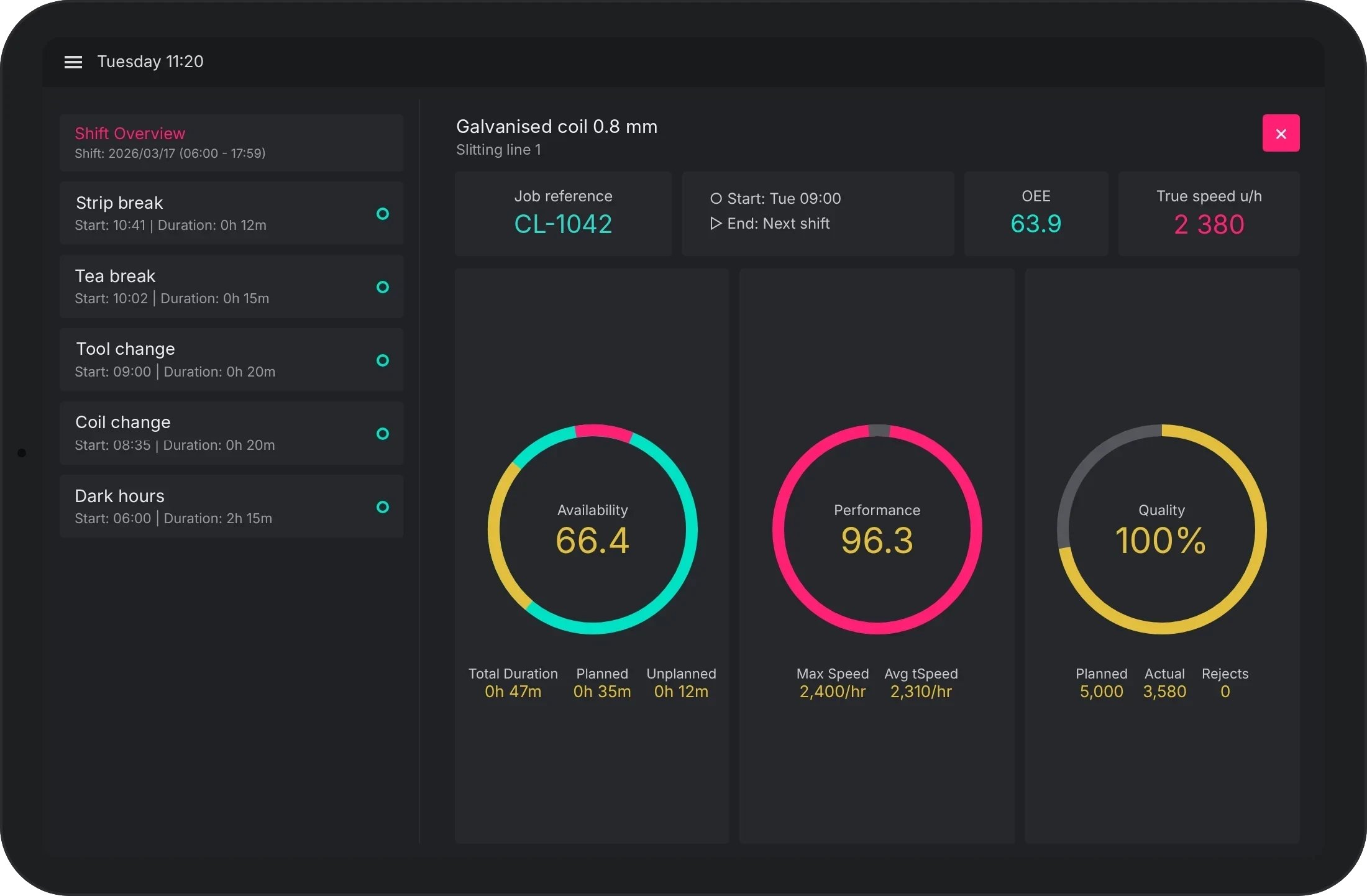
The Augos Operator Terminal sits in a stainless-steel enclosure beside the operator. The sensor is sealed against dust and water.
Recreated screen of the Augos Operator Terminal on demo data.
Questions
Steel and building materials, answered.
Will the sensor survive a heavy-industry floor?
The terminal sits in a sealed 304 stainless-steel enclosure designed to IP65, for −20 °C to +50 °C and 5 to 95% humidity, non-condensing. The count sensor is sealed to IP67 or better, chosen for the floor.
Can coil changes be compared across our sites?
Yes, when every site uses the same reason list and the same start and end points for a change. For multi-site groups ›
Do kilns and continuous lines fit?
Yes, where a sensor can see when product stops flowing.
See every coil change against its standard.
Thirty minutes with a manufacturing specialist: each change against standard, and the fastest your team has already done.
- Every change timed
- Standard and overrun split
- Prices in rand, ex VAT
A manufacturing specialist replies within two business hours to set a 30-minute call.