Augos Factory / Questions
Questions plant managers ask before they buy
The questions we hear most, answered straight.
In the order plant and operations managers raise them. What it asks of operators, whether the numbers hold up and whether people will use it. Then how it goes in, whether it touches your controls, and what it costs.
1 · Operators
What it asks of the people on the line
How much extra work is it for operators?
Operators give a reason only for stops longer than the stop threshold, with one or two taps on the Augos Operator Terminal. Shorter stops are counted and timed by the sensor with no input.
Does it report on individual operators?
Yes, by name. Each operator is compared with the line's own best, on what they can control, so supervisors know who to coach on which task. Who sees it is set by role. The shop-floor charter ›
What if an operator forgets to give a reason?
The stop stays timed and shows as uncoded. The share of stop time with a reason, shown in Pending Inputs, is a measure of the record for the manager, not a score on people.
What languages does the terminal support?
Stop reasons and product names are set up in your workbook, in any one language your floor uses.
2 · Trust
Whether the numbers hold
Can the numbers be trusted?
Yes. Counts, run time and stops are measured on the line and timestamped, and every total opens to the events behind it. Speeds, units per product and sales values are your settings, checked with you at go-live and every quarter. Data you can check ›
What happens when a figure looks wrong?
It is shown as measured, even above 100%, so it cannot hide. Augos checks the settings behind it with you at go-live and every quarter. Rated speed is checked against the nameplate rate, and units per product against a hand count. Measured counts and timestamps are never edited; a setting is changed with you, as a dated change.
Does Augos put a rand value on lost time?
No. The platform shows lost time in hours and as a share of paid time. Rand values come from each product's sales value, for what the line produced. You can estimate lost time yourself at an example value of an hour of net production, as the calculator does. The method ›
Do you claim a saving?
No. We report what was measured. Whether a change saved money is for your team to judge against the record.
3 · Adoption
Whether people will use it
We tried a system before and the floor stopped using it. Why is this different?
Most stops need no input at all. The terminal asks for one tap when a reason is needed, and supervisors get one short report each morning. We train operators and supervisors over two days on site. How we train your team ›
How do you introduce it to the union?
With the shop stewards, before go-live, using the shop-floor charter. Every operator is measured fairly against the line's own best, access is by role, and data is handled under POPIA.
What happens after go-live?
Four weekly one-hour data reviews with your specialist, then a review of reason codes and settings every quarter.
4 · Set-up
How it goes in
How long until the line is measuring?
Live within 48 hours of your kit arriving. Fill in one worksheet, give us a power supply by the bottleneck and mount the sensor. We switch it on over the air. Operator training follows.
What do you need from us?
One workbook (products, stop reasons, operators), a power supply near the bottleneck. Your team mounts the sensor and terminal with our guidance. Every terminal has 4G built in and comes with a data SIM at no cost; your own network works too, with your IT team's sign-off. Download the setup workbook (Excel) ›
Will installation stop production?
The sensor fits beside the line and reads product as it passes; no machine settings or programs change. Fitting takes only as long as mounting one sensor and one terminal; your team does it around your shifts, with our guidance.
5 · PLC and SCADA
Whether it touches your controls
Do you connect to our PLCs or SCADA?
No. Nothing is read from or written to your controls. One count sensor on the bottleneck sees every stop.
We already have SCADA. Why add a sensor?
SCADA records machine states. It rarely records why a line stopped, or which department can recover it. The sensor and terminal add those, without an integration project.
Does it connect to our ERP or BI tools?
Scheduled jobs come in from your ERP through the Augos API, and your ERP pulls job results back the same way. For your BI tools, several reports download as Excel or CSV. ERP job integration ›
6 · Price
What it costs
How much does Augos Factory cost?
R4,950 per line per month, ex VAT, plus a once-off deployment fee per line of R19,500, ex VAT. Pricing ›
What are the contract terms?
Every line starts with a three-month paid pilot: R19,500 deployment plus three months at R4,950, R34,350 ex VAT. A written success test is reviewed on day 60. After that, month to month with one month's notice. Augos owns the hardware.
What do the optional extras cost?
Maintenance calls cost R250 per technician per month, or R1,250 per site per month for unlimited technicians, both ex VAT. A rugged handheld is R6,450 ex VAT, or technicians use their own phones. Resource intensity is priced per measurement point at Augos Energy rates. Electricity is R3,000 per meter once, then R450 per meter per month, and water is from R150 per meter per month. The floor display is R300 per screen per month, or R1,500 per site per month for unlimited screens. The display module is R1,250 once per screen, and you supply the screen. All ex VAT.
We run in seasons. Can we pause between them?
Yes. A seasonal line can pause between seasons for R350 per month, ex VAT. The sensor and terminal stay mounted and your record and settings carry over, so there is no new deployment fee when the season starts. Each line runs at least three months a year at the full R4,950. Pricing ›
Can we try it first?
Yes, in three steps. A demo shows a month on a line like yours. A one-week line study times every stop on one of your own. Every line then starts with a three-month paid pilot and a written success test, reviewed on day 60. The line study › The paid pilot ›
How does the price compare with imported tools?
Imported tools are priced in dollars, so the rand cost moves with the exchange rate. The buyer's guide ›
7 · The company
Who you would be working with
Who is Augos?
A South African company based in Durbanville, Western Cape, which has measured utilities for South African plants since 2009, and production lines alongside them. About Augos ›
Where in South Africa do you work?
Anywhere in South Africa: Augos has measured sites in all nine provinces. Set-up, support and reports are remote, and our specialists train your team on site. Travel and accommodation for site visits are agreed in advance.
Who owns the data?
You do. Your data sits on Augos-owned servers in a hosted environment, protected under the Augos privacy policy and POPIA. Backups are stored in South Africa, and data is kept for at least five years after a contract ends, then deleted. Operator data is personal information under POPIA, with access by role.
For engineering, IT and procurement
The sheets your colleagues will ask for
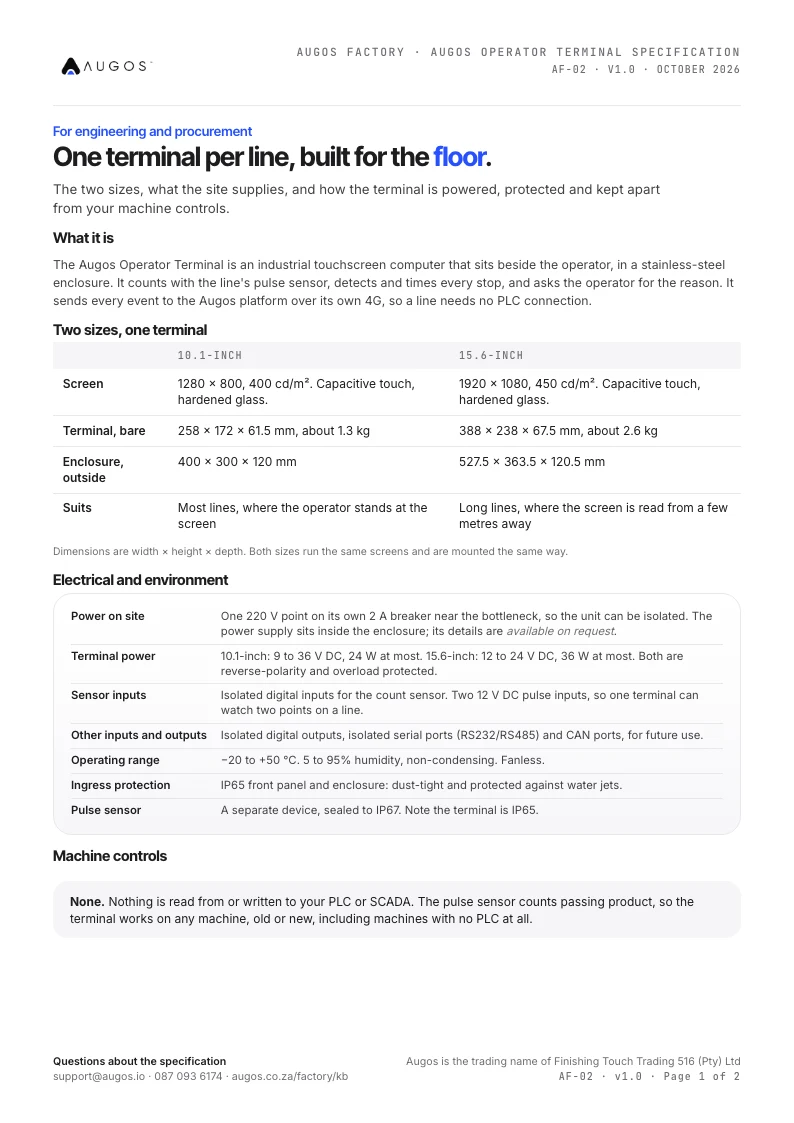
Operator terminal specification
Both terminal sizes, power, inputs, the enclosure and what comes in the box.
Download (PDF) ›
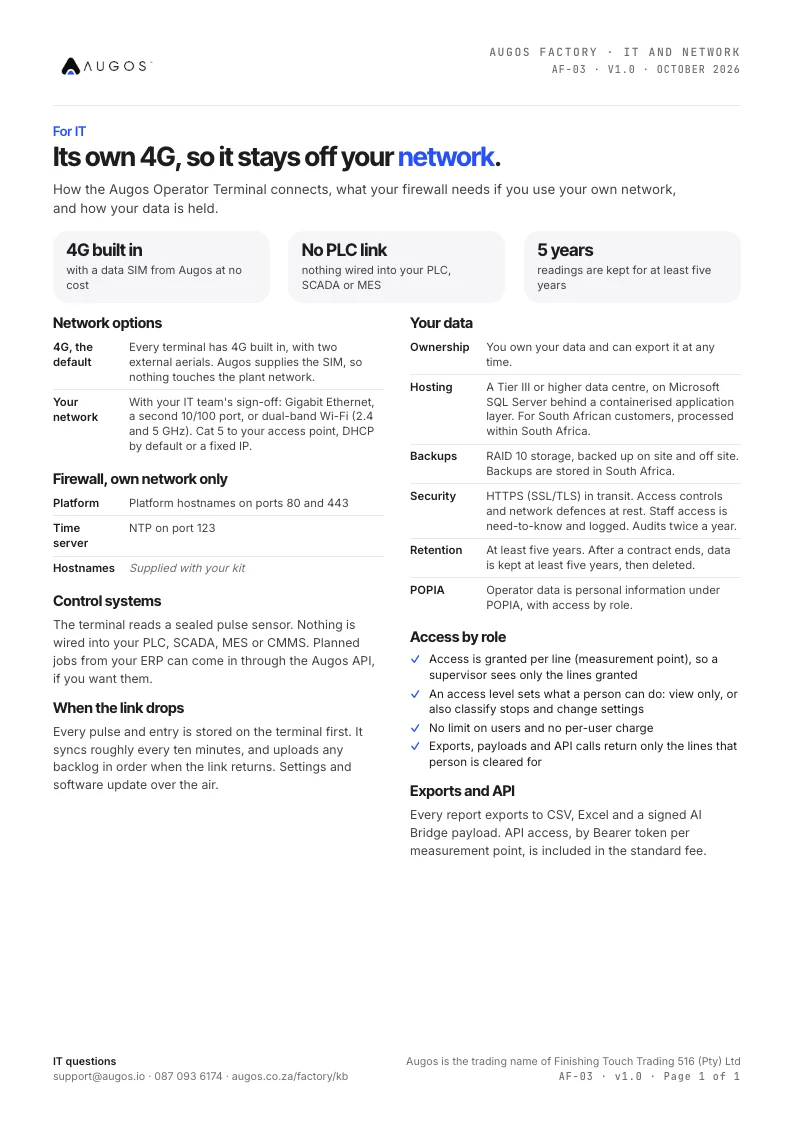
IT and network
How the terminal connects, what your firewall needs on your own network, and how data is held.
Download (PDF) ›
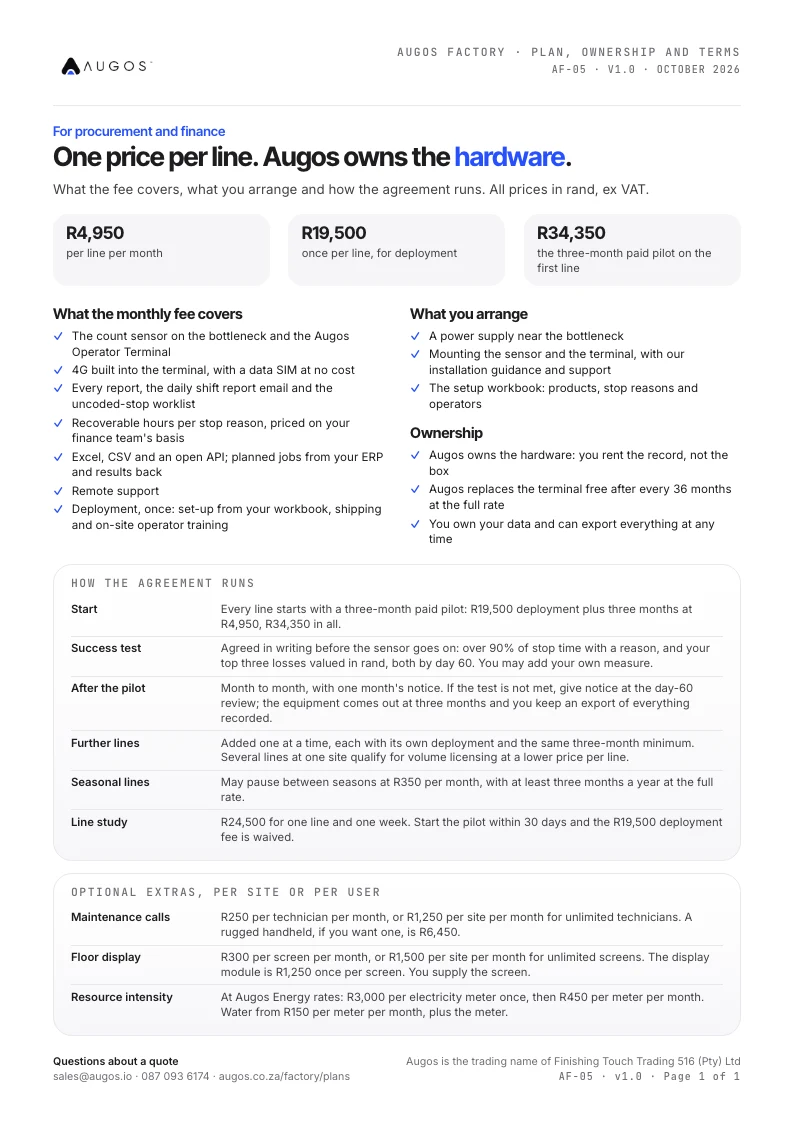
Plan, ownership and terms
One page for procurement: prices, what the fee covers, ownership and how the agreement runs.
Download (PDF) ›
Ask the question we did not answer.
Thirty minutes with a manufacturing specialist, on one of your lines.
- Your objections, answered on your data
- One line, one sensor, one terminal
- Prices in rand, ex VAT
A manufacturing specialist replies within two business hours to set a 30-minute call.