Augos Factory / About / Shop-floor data charter
The shop-floor data charter
Every operator measured fairly, against the line's own best.
How Augos Factory handles data about the people on the line. What is recorded, who sees it, how it is introduced, and what it is not for. Written for operators, shop stewards and HR as much as for managers.
The commitments
Seven things we commit to
Fair to every operator
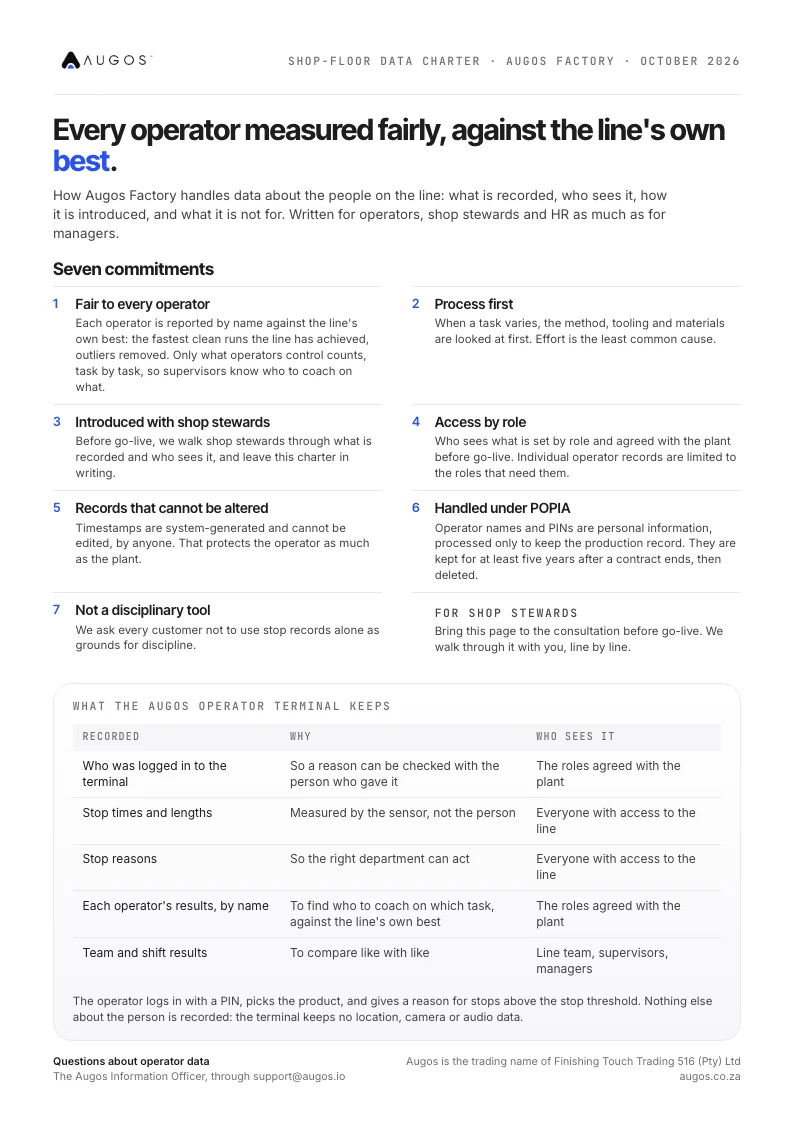
Each operator is reported by name against the line's own best: the fastest clean runs the line has achieved, with outliers removed. Operators are measured only on what they can control, task by task, so supervisors know who to coach on what.
Process first
When a task varies, the method, tooling and materials are looked at first. Effort is the least common cause. Variation ›
Introduced with shop stewards
Before go-live, we walk shop stewards through what is recorded and who sees it, and leave this charter in writing.
Access by role
Who sees what is set by role and agreed with the plant before go-live. Individual operator records are limited to the roles that need them.
Records that cannot be altered
Timestamps are system-generated and cannot be edited, by anyone. That protects the operator as much as the plant.
Handled under POPIA
Operator names and PINs are personal information, processed only to keep the production record. They are kept for at least five years after a contract ends, then deleted. Questions go to the Augos Information Officer through support@augos.io.
Not a disciplinary tool
We ask every customer not to use stop records alone as grounds for discipline.
What is recorded
Exactly what the Augos Operator Terminal keeps
The operator logs in with a PIN, picks the product, and gives a reason for stops above the stop threshold. Nothing else about the person is recorded: the terminal keeps no location, camera or audio data.
| Recorded | Why | Who sees it |
|---|---|---|
| Who was logged in to the terminal | So a reason can be checked with the person who gave it | The roles agreed with the plant |
| Stop times and lengths | Measured by the sensor, not the person | Everyone with access to the line |
| Stop reasons | So the right department can act | Everyone with access to the line |
| Each operator's results, by name | To find who to coach on which task, against the line's own best | The roles agreed with the plant |
| Team and shift results | To compare like with like | Line team, supervisors, managers |
For shop stewards
One page to take to the meeting
The seven commitments and the table above, on one page, for the consultation before go-live.
The one-page summary
A4 · PDF
Questions
Shop-floor data, answered
Can management see what each operator did?
Yes. The roles agreed with the plant see each operator's results by name, against the line's own best. They also see who was logged in when each reason was given. The comparison is there for coaching: it shows who is strong at which task, and who needs help.
Can a supervisor change a stop time?
No. Timestamps are system-generated and cannot be edited. A reason can be corrected, and the correction is logged with who changed it and when.
Where is the data held?
Your data sits on Augos-owned servers in a hosted environment, protected under the Augos privacy policy and POPIA. Backups are stored in South Africa, and data is kept for at least five years after a contract ends, then deleted.
Walk your shop stewards through it with us.
Thirty minutes with a manufacturing specialist, before anything goes on a line.
- What is recorded, and what is not
- Who sees what
- The charter in writing
A manufacturing specialist replies within two business hours to set a 30-minute call.