Augos Factory / Proof / Clay-brick plant
Case study · Building materials · Western Cape
The stop record showed which machine to fix first.
Two brick lines lost 183.3 hours to breakdowns in one month. The plant's production manager used the stop record to show how much of it two packing machines caused.
The situation
Which machine to fix first
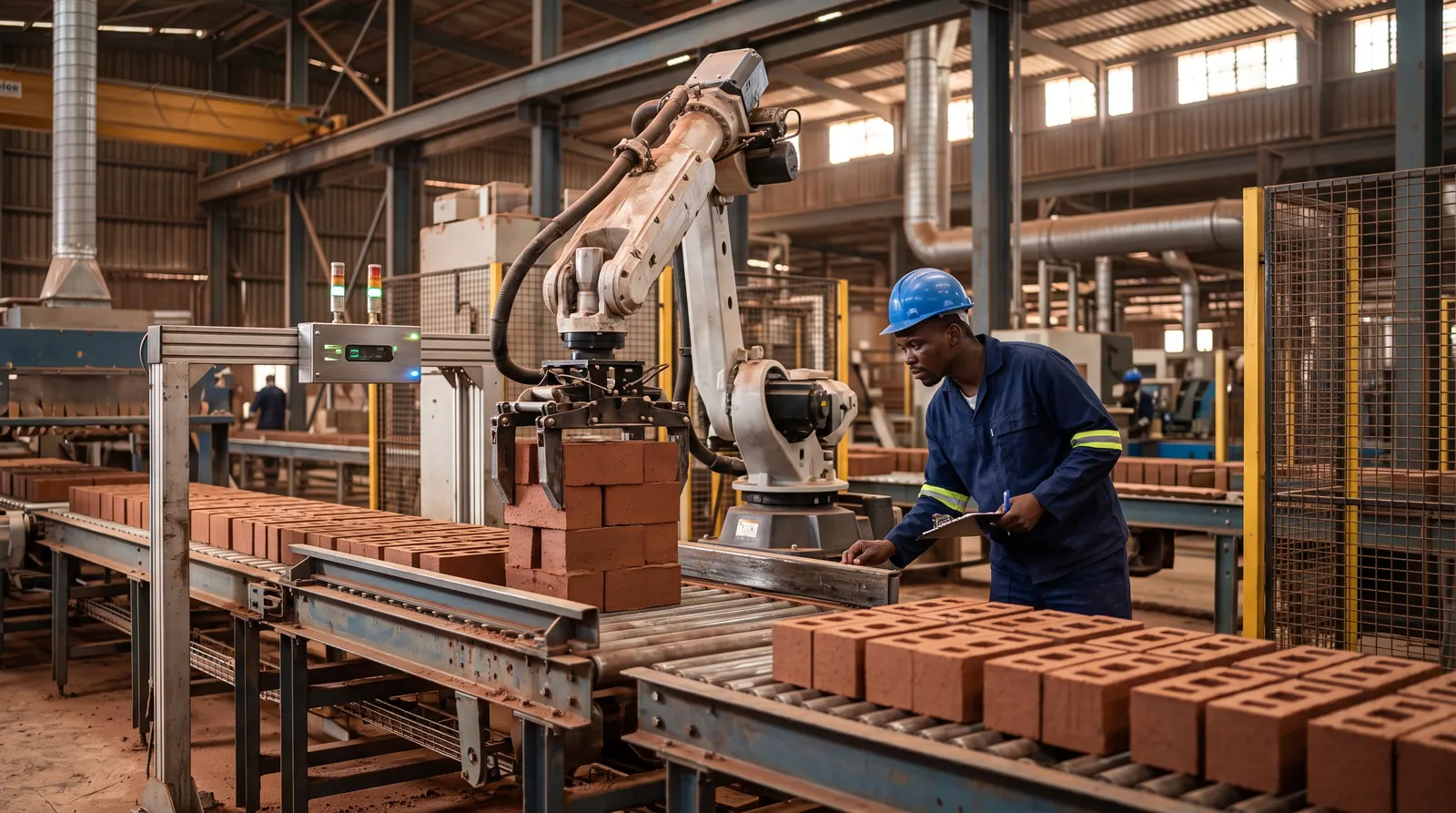
A clay-brick plant runs two lines. Each ends in a packing cell with a brick picker and packing robots, and each has one sensor and one Augos Operator Terminal.
Every stop is timed by the sensor and given a reason at the line. The production manager wanted to know how much of the breakdown time two packing machines caused.
What the record showed
Two machines, two different lines
Breakdown time by line, with the share from two packing machines, one month:
| Machine | Line A | Line B |
|---|---|---|
| All breakdowns | 93.7 h | 89.6 h |
| Brick picker | 91 stops, 4.35 h, 4.6% | 53 stops, 7.28 h, 8.1% |
| Robot 3 | 38 stops, 3.99 h, 4.3% | 25 stops, 1.33 h, 1.5% |
Line B
8.1% of line B's breakdown time came from its brick picker, more than five times the share of the robot beside it.
Source: Augos platform, Downtime Report, breakdown category. Two anonymised clay-brick lines, one month across 2025 and 2026. Site, products and people removed. Analysis by the plant's production manager.
What the report found
Why each machine stopped
The production manager read the stop reasons behind each machine's hours, then set out how each fault happened.
Brick picker: position drift
The picker's reference position drifted, so it picked in slightly the wrong place. Each error meant a stop, a reset to its start position and a restart.
Brick picker: handling
Uneven brick spacing upset the timing, so bricks were dropped, left behind or shaved.
Robot 3: pack presentation
Packs that were not square, or varied in height, were hooked or half picked. Frequent resets then pushed its settings out.
On line B, the report read the picker's share as waiting and coordination with the next machine, more than the robot itself.
Method
- Source: Augos platform Downtime Report, every stop logged under the breakdown category.
- Analysis: written by the plant's own production manager.
- Period: one month across 2025 and 2026.
- Lines: two clay-brick lines, each with its own picker and robots.
What this case leaves out
- No rand value: the plant has not shared its products' sales values, so the case reports hours.
- One month only. A later month will be added when the plant shares it.
Measured figures only, as the platform recorded them.
Questions
This case, answered
How did the plant find which machine to fix?
From the Augos Downtime Report. Because every stop had a timed record and a reason given at the line, the plant's production manager could trace breakdown time to each machine and see why it stopped. The analysis is theirs; the data made it possible.
How were the stops recorded?
Every stop is timed by the line sensor and given a reason at the line, on the Augos Operator Terminal.
Why is there no rand value?
The plant has not shared its products' sales values, so the case reports hours. A rand value can be added when the plant supplies them.
Find losses like these on your own line.
Thirty minutes with a manufacturing specialist, on your own lines and products.
- Every stop timed and given a reason
- Read by your own team
- Prices in rand, ex VAT
A manufacturing specialist replies within two business hours to set a 30-minute call.