Augos Electricity Meter
The Augos Electricity Meter is the three-phase smart meter behind every electricity report, a permanent, DIN-rail unit measured to billing accuracy.
1 · What it is
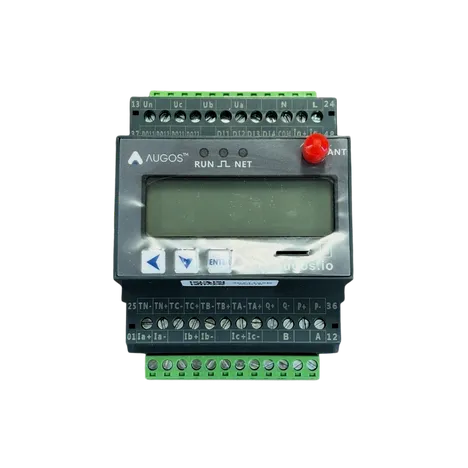
The Augos Electricity Meter is a compact, DIN-rail-mounted three-phase smart meter for commercial and industrial supplies. It clamps onto an existing feed with current transformers, measures the full electrical picture at the panel, and sends it to the platform over its built-in 4G link. It's a permanent fixture, the source of the continuous electricity data the reports run on: it captures interval data on board and reports down to 60-second updates, with full buffering and automatic backfill if the connection drops.
2 · What it measures
Three-phase voltage and current; active, reactive and apparent power; energy import and export, four-quadrant; power factor; frequency; demand; and harmonic distortion from the 2nd to the 31st. Bidirectional measurement supports sites with solar or other on-site generation.
3 · Specifications
| Accuracy | Active energy Class 0.5S; voltage and current ±0.2%; frequency ±0.02 Hz |
| Type approval | Type-tested to IEC 62052-11 and IEC 62053-22 at Class 0.5S, at an ISO/IEC 17025-accredited national metrology laboratory |
| Calibration | Every unit calibrated at manufacture. A random 10% of each shipment is then independently tested by a SANAS-accredited calibration laboratory in terms of SANS 474, traceable to NMISA, the national metrology institute. Latest results, September 2026: five meters, 35 test points, all within limits; the largest error was 0.08% against a ±0.60% limit, with a measurement uncertainty of ±0.04% |
| Voltage input | Configurable (100 V up to 380/660 V); L-N 10–380 V AC, L-L 90–660 V AC |
| Current input | Via CT, 1 A or 5 A rated; split-core CTs available |
| Frequency range | 45–65 Hz |
| Wiring | Star (3P4W) or delta (3P3W) |
| Power quality | 2nd–31st harmonic measurement; total harmonic distortion (THD) |
| Connectivity | 4G cellular as standard, with Modbus outputs; Wi-Fi and other versions on request, delivering the same data |
| Data handling | On-device capture and buffering; automatic backfill to the platform after an outage |
| Auxiliary power | 85–265 V AC / 80–300 V DC, <3 VA |
| Environment | −25 to +70 °C; 5–95% RH non-condensing; up to 3000 m |
| Dimensions | 74 × 75 × 88 mm, DIN-rail mounted |
| Compliance | CE / IEC; EMC immunity to IEC 61000-4 level 4 |
4 · Where it's used
The Augos Electricity Meter is the electricity source behind every module on the platform:
- Dashboard and Consumption breakdown, for consumption and demand across the hierarchy.
- Cost breakdown, Cost allocation and Bill verification, priced, split and checked against the bill.
- Time of use and Tariff comparison, for timing and tariff.
- Power factor & demand and Technical analysis, for the electrical detail.
- Charting, Data download and Triggers & alerts, to plot, export and alert on any reading.
See what we measure for electricity for the readings it captures.
5 · Common questions
Is the Augos Electricity Meter accurate enough for billing?
Yes. It’s type-tested to IEC 62052-11 and IEC 62053-22 at Class 0.5S, the grade used for revenue and tariff billing, at an ISO/IEC 17025-accredited national metrology laboratory. Every unit is calibrated at manufacture, and a random 10% of each shipment is then independently tested by a SANAS-accredited calibration laboratory in terms of SANS 474, traceable to South Africa’s national measurement standards (NMISA). In the latest check, in September 2026, all 35 test points on five meters were within limits.
How disruptive is fitting it?
Minimal. It reads the supply through current transformers, with split-core CTs available, and is fitted by a qualified electrician as part of normal switchboard work.
Does it need to be wired into my network?
No. It reports over its own 4G connection as standard, with Modbus outputs on the meter. Wi-Fi and other versions are available on request and deliver the same data. It also captures and buffers on board and backfills automatically if the connection drops, so no readings are lost during an outage.
Does it work on a site with solar or generators?
Yes. It measures four-quadrant, both import and export, so on-site generation is captured rather than confusing the reading.
How often does it report?
Down to 60-second intervals. Because it draws power from the supply it’s reading, it isn’t limited by a battery and can report at high resolution.